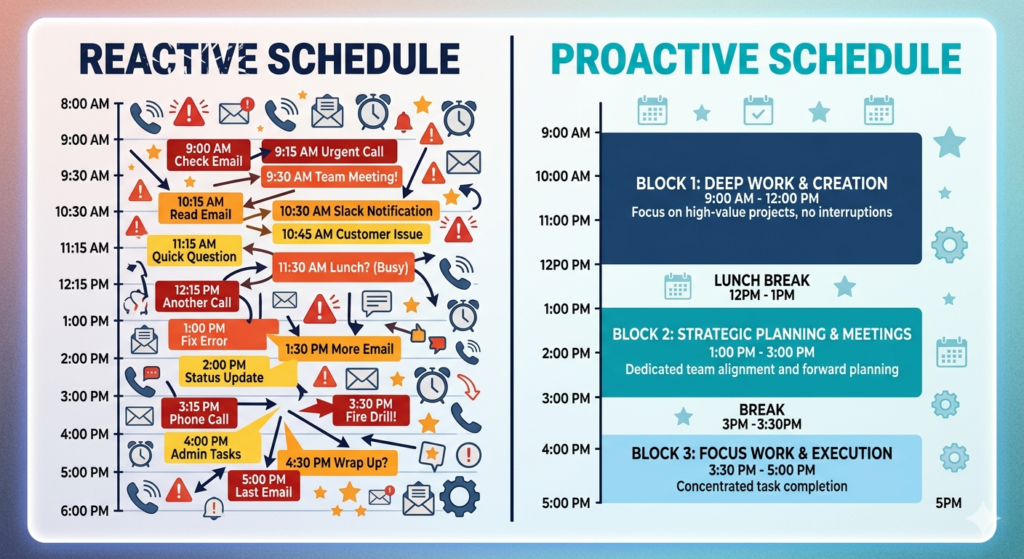
Many professionals end their workday feeling exhausted, yet when they review their accomplishments, they realize they spent eight hours merely reacting to the demands of others. If you wait until you have “free time” to tackle your most important projects, those projects will never get done. Meaningful, cognitively demanding tasks require proactive deep work scheduling.
You cannot simply hope for a distraction-free hour to magically appear in the middle of a chaotic corporate environment. To achieve high-value output, you must engineer your day with strict intention. This “how-to” guide outlines exactly how to structure your daily routine, utilizing proven calendar methodologies to protect your attention, minimize friction, and transform concentration into a predictable daily habit.

The Foundation of Focus Scheduling
Before mapping out your week, it is critical to understand what this type of scheduling actually entails.
Deep work scheduling is the deliberate practice of allocating specific, uninterrupted blocks of time in your calendar dedicated solely to cognitively demanding tasks. This proactive calendar management strategy prioritizes high-value output over reactive busywork, ensuring that focused concentration becomes a daily routine rather than a rare accident.
The core issue for most knowledge workers is that they allow their email inbox or instant messaging applications to dictate their schedule. When you operate in a purely reactive state, your cognitive energy is depleted by shallow logistical tasks. A proper schedule flips this dynamic, securing your most alert hours for complex problem-solving before the noise of the day can interfere.
Mastering Time Blocking and Calendar Management
The most effective tactical approach to organizing your day is a method known as time blocking.
Time blocking involves dividing your day into distinct blocks of time, assigning a specific job or task to every single minute. Instead of working from an open-ended to-do list, you schedule exactly when you will perform a task and for how long. For example, instead of a vague goal to “write a report,” you block out 9:00 AM to 11:00 AM exclusively for drafting the report.
Effective calendar management requires externalizing this plan. While digital calendars are useful for meetings, many top performers find that physically mapping out their time blocks in a high-quality Paper Planner or Moleskine provides a stronger psychological anchor. Writing the schedule down by hand reduces the temptation to endlessly drag and drop digital events, turning a loose intention into a firm commitment.
The Rhythmic Philosophy for Daily Consistency
When deciding exactly when to place these blocks, you must choose an underlying structural approach. The most accessible method for the standard office worker is the rhythmic philosophy.
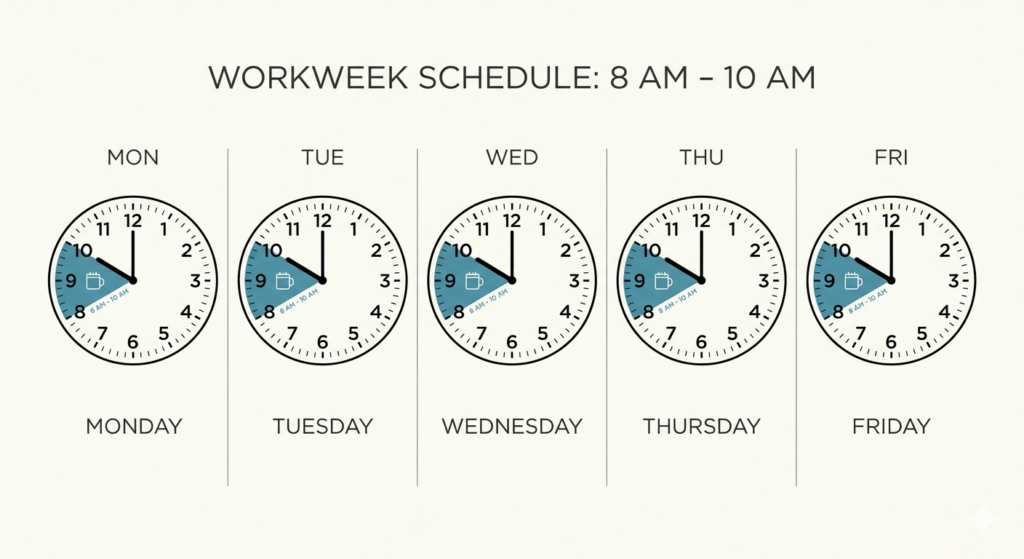
The rhythmic philosophy dictates that you schedule your deep efforts for the exact same time every single day. By turning focus into a strict daily rhythm (for example, every morning from 8:00 AM to 10:00 AM), you entirely remove decision fatigue from the process. You no longer have to decide if or when you will do the hard work; you simply execute the routine.
This approach is highly effective because it relies on behavioral conditioning. Over time, your brain learns to automatically drop into a state of high concentration as soon as that specific hour arrives. If you want to review the underlying theory of why this intensity is so necessary, brushing up on the Definition of Deep Work provides excellent context for this daily practice.
The Bimodal Philosophy for Extreme Output
If your profession demands periods of extreme, unbroken isolation—such as writing a book, programming complex software, or academic research—the rhythmic approach may not provide enough continuous runway. In these cases, the bimodal philosophy is often superior.
The bimodal philosophy involves dividing your schedule into two distinct modes. In “deep mode,” you isolate yourself entirely for days or even weeks at a time to focus intensely on a single objective. In “shallow mode,” you return to standard availability, answering emails, attending meetings, and catching up on logistical tasks.
This approach requires a high degree of professional autonomy. It is typically utilized by tenured professors or independent creators who can afford to vanish from their inboxes for four consecutive days without facing professional consequences.
Protecting the Plan and Handling Interruptions
A schedule is only as useful as your ability to adhere to it. Inevitably, emergencies will arise, and colleagues will attempt to encroach on your blocked time.
Protecting your schedule requires firm communication. If a coworker requests a meeting during your focus block, politely offer them an alternative time during your designated “shallow work” hours. Furthermore, always build buffer blocks into your day. If you estimate a task will take two hours, block off two and a half.
If a true emergency derails your morning, do not abandon the entire system. Simply take five minutes to re-block the remainder of your day, shifting your priorities as needed. The goal is not rigid perfection; the goal is continuous intention.
Conclusion
Mastering deep work scheduling is a transformative skill that separates highly effective professionals from those who are merely busy. By utilizing time blocking and proactive calendar management, you take ownership of your most valuable resource: your attention. Whether you adopt the daily consistency of the rhythmic philosophy or the intense isolation of the bimodal philosophy, structuring your day with intention ensures that complex, high-value tasks are consistently accomplished. Stop waiting for the perfect moment to work, and start engineering your environment for success.
Frequently Asked Questions (FAQ)
What is time blocking?
Time blocking is a time management method where you divide your day into specific blocks of time. Each block is dedicated to accomplishing a specific task or group of tasks, replacing the traditional open-ended to-do list with a structured schedule.
What is the rhythmic philosophy of deep work?
The rhythmic philosophy involves scheduling your cognitively demanding tasks for the exact same time every single day (e.g., 8:00 AM to 10:00 AM). This builds a strong behavioral habit and removes the daily friction of deciding when to focus.
How does the bimodal philosophy differ from the rhythmic?
While rhythmic scheduling happens daily, the bimodal philosophy divides time on a macro scale. A practitioner might spend four full days completely isolated doing deep work (mode one), and the remaining three days handling meetings, emails, and shallow logistical tasks (mode two).
What should I do if my scheduled block gets interrupted by an emergency?
When an unavoidable emergency disrupts your plan, handle the situation, and then immediately take five minutes to re-block the rest of your day. The system is meant to be flexible. The goal is to always know what you should be doing right now, even if the original plan changes.