In today’s modern workplace, being “busy” is often mistaken for being productive. We spend our days furiously replying to emails, attending back-to-back meetings, and constantly checking notifications. Yet, when Friday afternoon arrives, it is common to feel as though nothing meaningful was actually accomplished. This pervasive sense of exhaustion without achievement points to a fundamental flaw in how we approach our daily tasks.
To truly excel and produce meaningful results, we must fundamentally shift our approach to concentration. Exploring the definition of deep work provides the core philosophy required to reclaim your time and attention. This comprehensive guide serves as the foundation for mastering distraction, helping you understand the underlying psychology of focus and how to structure your environment for ultimate productivity.

The Core Philosophy
To master your concentration, you must first understand exactly what you are trying to achieve.
The definition of deep work is a professional activity performed in a state of distraction-free concentration that pushes your cognitive capabilities to their absolute limit. These focused efforts create new value, drastically improve your skills, and produce results that are incredibly hard to replicate.
This concept is the absolute antithesis of the modern, hyper-connected work environment. It recognizes that human attention is a finite and highly valuable resource. When you sit down to perform deep efforts, you are not just ticking a box on a to-do list; you are actively engaging the most complex reasoning centers of your brain.

Exploring Cal Newport Concepts
The terminology we use today was popularized by Cal Newport, a computer science professor at Georgetown University. He introduced these ideas in his 2012 blog and fully expanded upon them in his 2016 bestselling book.
Central to the various Cal Newport concepts is the hypothesis that the ability to perform deep efforts is becoming increasingly rare at the exact same time it is becoming increasingly valuable in our economy. As automation and artificial intelligence handle more routine tasks, the economic premium is shifting toward humans who can quickly master complex systems and think creatively.
Newport outlines several scheduling philosophies to help individuals integrate this practice into their lives. Whether you isolate yourself completely for weeks (the Monastic philosophy) or strictly schedule 90-minute blocks every morning (the Rhythmic philosophy), the goal remains the same: protecting your time from the steady drip of distraction.
Shallow Work vs Deep Work
To fully grasp this methodology, it is crucial to understand what deep work is not. The clearest way to define it is by exploring the contrast of shallow work vs deep work.
Shallow work consists of non-cognitively demanding, logistical-style tasks. These are the chores you can easily perform while slightly distracted, such as responding to routine emails, filling out standard data entry forms, or attending status-update meetings. While shallow work is necessary to keep the lights on in any business, it rarely creates new value in the world.
Deep work, conversely, requires your undivided attention. Writing a novel, coding a new software application, or developing a complex financial model cannot be done well while checking a group chat. The danger of the modern workplace is that shallow work naturally expands to fill all your available time if you do not actively defend against it.
The Pursuit of High-Value Output
The ultimate goal of adopting this methodology is to radically transform the quality of your professional contributions. You are transitioning from a manager of logistics to a creator of high-value output.
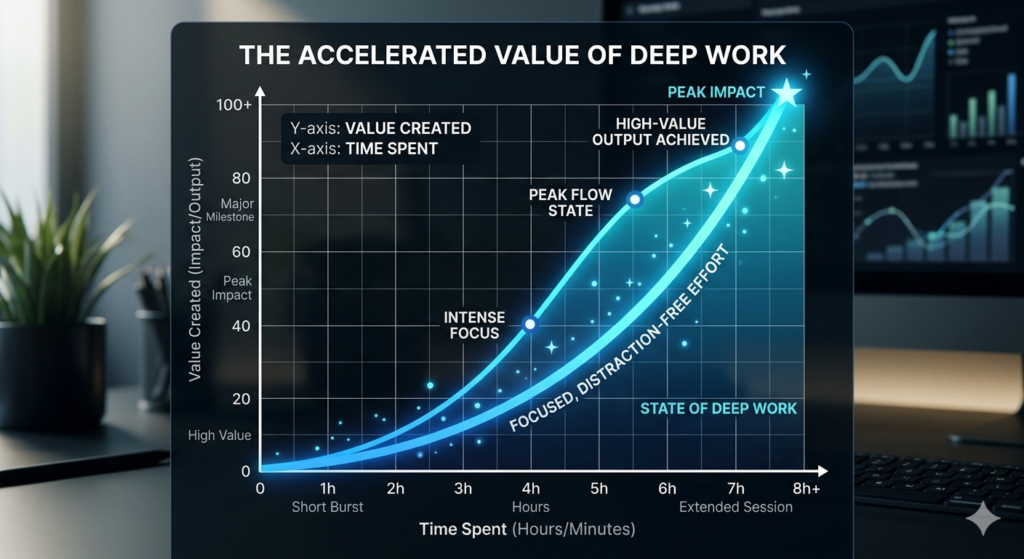
High-value output is work that makes a measurable, significant impact on your career or your company. It is the type of work that cannot be easily replicated by a junior employee or a software algorithm. Because this output requires pushing your cognitive capabilities to the edge, it is naturally exhausting and cannot be sustained for eight hours a day.
Most experts agree that the absolute maximum capacity for this intense level of focus is roughly four hours per day. Therefore, maximizing those precious hours is the single most important metric for an ambitious knowledge worker.
How to Build Your Practice
Transitioning from a distracted worker to a deep worker requires training. Focus is not merely a habit; it is a mental muscle that atrophies if not used.
Start by scheduling a single, non-negotiable hour of absolute focus into your calendar. During this time, turn off all notifications, close your email tab, and put your phone in another room. Utilizing a physical timer on your desk serves as a powerful visual anchor. When the sand is falling, your brain knows it is time to work, effectively separating your deep session from the shallow chaos of the rest of the day.
As your mental endurance improves, you can gradually increase these sessions. Over time, you will find that a few hours of undistracted focus yields more progress than an entire week of fragmented, shallow busywork.
Conclusion
Understanding the true definition of deep work is the first step toward reclaiming your professional life from the endless noise of the modern world. By distinguishing the critical difference between shallow work vs deep work, and actively applying Cal Newport concepts to your daily routine, you set the stage for profound career growth. Pushing your cognitive capabilities to their limits is undoubtedly challenging, but it is the only reliable path to producing the high-value output that truly matters. Guard your attention fiercely, and your productivity will soar.
Frequently Asked Questions (FAQ)
Who coined the term deep work?
The term was coined by Cal Newport, a computer science professor at Georgetown University. He first introduced the concept on his blog and later expanded it into the 2016 bestselling book, Deep Work: Rules for Focused Success in a Distracted World.
What is the difference between shallow work vs deep work?
Shallow work consists of easy, logistical tasks (like answering emails) that can be done while distracted and do not create new value. Deep work involves cognitively demanding tasks performed in a state of absolute concentration that create significant value and improve your skills.
How long should a deep work session last?
For beginners, a session might only last 45 to 60 minutes before mental fatigue sets in. However, with practice, highly trained knowledge workers can sustain intense focus for up to 90 to 120 minutes per session, capping at a maximum of about four hours total per day.
What are the 4 philosophies of deep work scheduling?
Cal Newport identifies four approaches: Monastic (isolating yourself completely for long periods), Bimodal (dividing your week or month into clear deep and shallow periods), Rhythmic (scheduling the exact same time every day for focus), and Journalistic (fitting focus blocks wherever they fit into a shifting daily schedule).