For decades, the standard for computer displays has been backlit technology, primarily LCD and LED screens. While these monitors produce incredibly vibrant colors and sharp images, they also beam intense, flickering light directly into the user’s eyes for hours on end. For professionals who spend their entire day reading, writing, or coding, this constant exposure often leads to severe visual fatigue and tension headaches.
As awareness of digital wellness grows, an alternative hardware solution is quietly gaining traction in modern offices. If you frequently suffer from screen-induced headaches, you might be asking: why use an e-ink monitor instead of a traditional display? This educational guide breaks down the physical mechanics of this unique technology, explaining how ditching the backlight can fundamentally transform your daily cognitive endurance.
The Technology Behind Electronic Paper
To understand the physical benefits, we must first look at how the display actually generates an image.
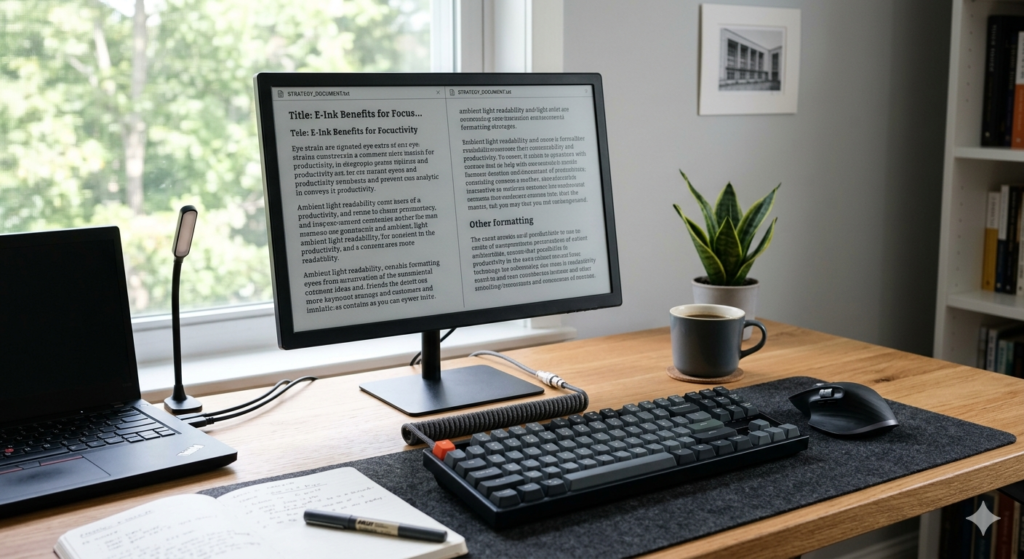
Why use an e-ink monitor? An e-ink monitor utilizes electronic paper technology that reflects ambient room light instead of emitting its own backlit glow. This provides a glare-free viewing experience that drastically reduces eye strain during prolonged reading, writing, or coding sessions.
Unlike LCD screens, which use liquid crystals to block a constant backlight, electronic paper relies on millions of tiny microcapsules suspended in a clear fluid. These microcapsules contain positively charged white particles and negatively charged black particles. When a positive or negative electrical field is applied to a specific pixel, the corresponding particles rise to the top of the capsule.
Because the display relies on physical pigments rather than glowing diodes, it looks and behaves exactly like printed ink on a physical page. The image remains visible even if the power is cut off.
Achieving Zero Blue Light and Eye Comfort
The most significant health advantage of this technology is how it interacts with the human optical system. Traditional monitors use transmissive light, meaning the light source originates behind the screen and shines directly into your retina.
E-ink monitors rely entirely on reflective light. Just like a physical book, you can only read the screen if there is ambient light in the room. Because there is no backlight, the screen inherently produces zero blue light emissions from the panel itself.
This absence of high-energy digital glare eliminates the primary cause of muscular eye fatigue. If you are currently struggling with the symptoms outlined in our guide on Computer Eye Strain, switching to a reflective display offers an immediate, physical remedy. It allows your ocular muscles to relax and function as if they were reading a traditional paperback novel.
The Experience of a Paper-Like Display
Typing on an electronic ink monitor is a fundamentally different sensory experience than using a standard glowing screen. It strips away all the visual noise associated with modern computing.
Because the screen lacks a glass glare layer and backlighting, you get a true paper-like display. The contrast is sharp and matte, making it incredibly comfortable to read dense blocks of text or thousands of lines of code. The removal of bright colors and flashing advertisements naturally guides the brain toward a calmer, more focused state.
For writers, researchers, and programmers, this technology is an invaluable tool for single-tasking. Many professionals utilize a dedicated Dasung or Boox E-ink Tablet as a secondary display used exclusively for drafting documents, allowing them to escape the fatiguing glare of their primary color monitor.
Understanding Refresh Rates and Limitations
While the ergonomic benefits are profound, it is highly important to understand the objective limitations of this hardware. E-ink is not a universal replacement for all computer monitors.
Because the technology relies on physically moving pigment particles, the refresh rates are significantly slower than those of an LCD or OLED screen. While modern standard monitors refresh 60 to 144 times per second, e-ink panels refresh much slower. This can lead to “ghosting,” where a faint outline of the previous image remains on the screen for a few seconds.
Consequently, these monitors are entirely unsuitable for video editing, gaming, or watching high-definition movies. They are specialized tools engineered explicitly for static, text-based, deep work.
Conclusion
Deciding why use an e-ink monitor comes down to evaluating your daily tasks and your physical visual comfort. If your work requires color accuracy, fast-moving video, or rapid graphical rendering, this technology is not the right fit. However, if you spend your days processing words and code, the benefits are undeniable. By utilizing electronic paper, you trade fast refresh rates for profound eye comfort. The zero blue light, reflective nature of a paper-like display provides a sanctuary for tired eyes, allowing professionals to maintain deep focus without the painful physical toll of traditional backlights.
Frequently Asked Questions (FAQ)
What is an e-ink monitor?
An e-ink monitor is a computer display that uses electronic paper technology. Instead of using a glowing backlight to show images, it uses electrical charges to move physical black and white pigments, creating a display that looks and acts like printed paper.
Do e-ink monitors emit blue light?
No, inherently they do not. Because they rely on reflecting ambient room light rather than shining a backlight directly at the user, they offer a zero blue light experience. (Note: Some devices have built-in “front-lights” for reading in the dark, but these can be adjusted to warm tones or turned off entirely).
Can you watch videos on an e-ink display?
While newer models have “fast modes” that can technically play video, it is highly discouraged. The slow refresh rates cause severe ghosting and stuttering, making it an incredibly poor experience for moving media.
Why are e-ink monitors so expensive?
The manufacturing process for large electronic paper displays is highly complex, and the market is relatively niche compared to mass-produced LCD screens. This lack of massive economies of scale keeps the pricing for dedicated desktop e-ink monitors quite high.