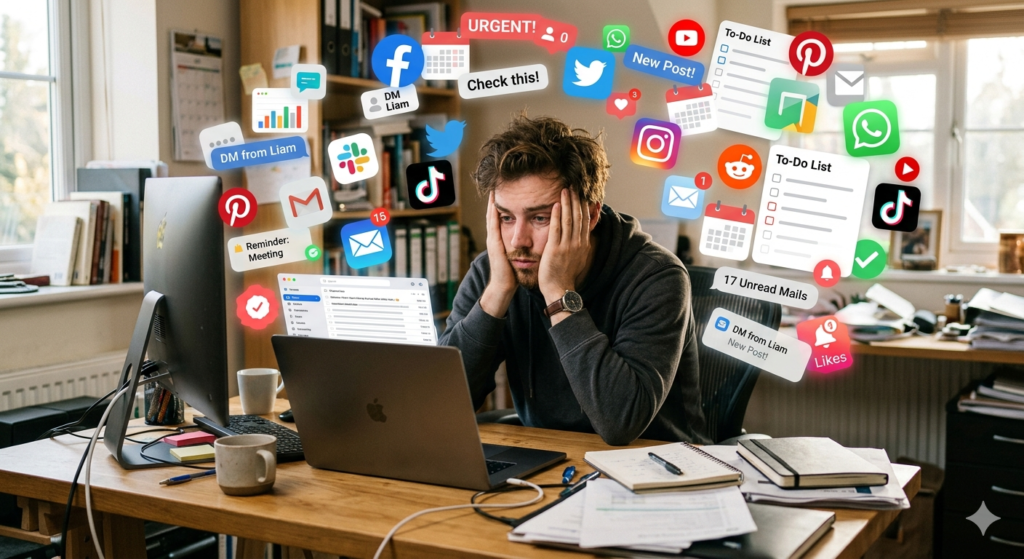
It is a remarkably common scenario: you sit down at your desk with a clear plan to tackle an important project. You open your laptop, ready to work. Twenty minutes later, you find yourself endlessly scrolling through social media or reorganizing your email folders, completely off-task. If you frequently find yourself asking, “why do I get distracted so easily?”, it is important to understand that you are not simply lacking willpower.
Chronic distractibility is a natural biological response to an unnatural modern environment. Our brains are constantly navigating a minefield of notifications, open tabs, and underlying anxieties. This troubleshooting guide breaks down the psychological and environmental factors that hijack your focus, helping you identify exactly what is pulling you away from your work and how to fix it.
The Biology of Chronic Distraction
To fix a wandering mind, we must first define the problem in neurological terms.
Chronic distraction is the ongoing inability to maintain focus on a single task due to a combination of biological habits and environmental interruptions. It occurs when the brain’s reward system becomes conditioned to seek the immediate, low-effort dopamine hits provided by continuous context switching.
Your brain is naturally tuned to prioritize novel stimuli. This biological mechanism is designed to monitor your environment for sudden changes, instantly shifting your focus toward new information. Today, that same internal system is triggered by a vibrating smartphone or a pop-up ad. When you give in to that distraction, your brain rewards you with a tiny spike of dopamine, reinforcing the habit of looking away from deep, meaningful work.
Unpacking Multitasking Myths
A major reason people struggle with distractibility is the belief that they can do multiple things at once. The corporate world often praises multitasking, but neuroscience tells a very different story.
One of the most pervasive multitasking myths is that the human brain can process two complex cognitive tasks simultaneously. In reality, the brain engages in rapid “task-switching.” When you try to write a report and check your phone at the same time, your brain is furiously shifting its processing power back and forth.
This rapid switching depletes glucose, the brain’s primary energy source, leading to faster mental fatigue. The more you try to multitask, the more exhausted your brain becomes, making it increasingly difficult to resist further distractions.
The Hidden Cost of Attention Residue
Even if you only glance at a text message for a few seconds, the cognitive cost is much higher than you realize. This is due to a psychological concept known as attention residue.
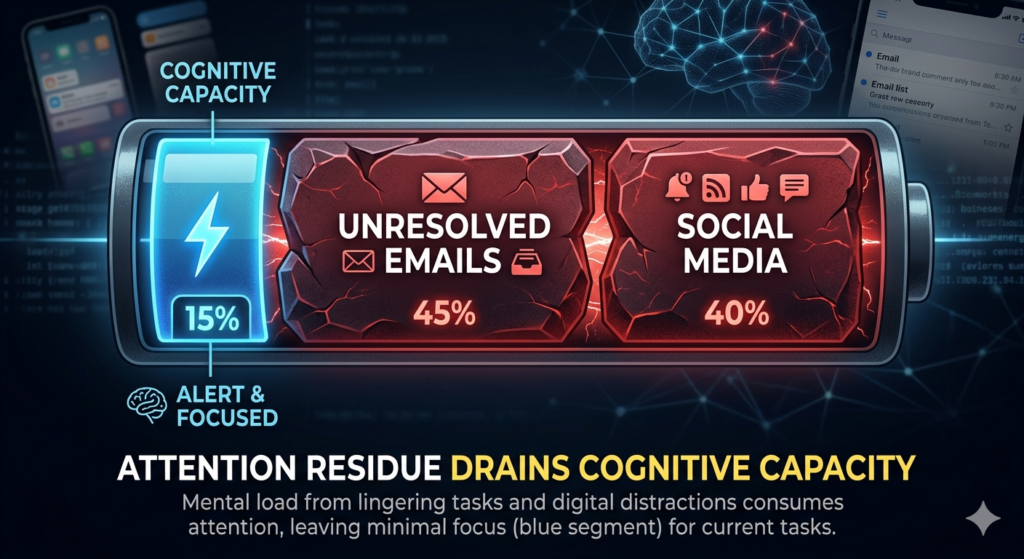
When you shift your focus from Task A to Task B, your attention does not cleanly transfer. A portion of your cognitive processing power remains “stuck” thinking about Task A. If you check an unresolved email in the middle of writing a document, your brain continues to process that email in the background, leaving you with less mental capacity for the writing task.
As you bounce between tabs and apps throughout the day, this residue accumulates. By mid-afternoon, your cognitive capacity is severely diminished. Understanding the broader Science of Focus highlights why sequential, single-tasking is the only biologically sustainable way to work.
External Triggers vs. Internal Triggers
To stop getting distracted, you need to identify the root cause of the interruption. Distractions generally fall into two distinct categories.
External Triggers
External triggers are cues from your environment. These are the pings, dings, rings, and visual interruptions that demand your attention. A colleague walking up to your desk, a push notification on your watch, or a cluttered, messy workspace are all external triggers. These are the easiest to solve by physically altering your environment.
Internal Triggers
Internal triggers are much more insidious. These are internal feelings of discomfort that prompt you to seek a distraction. Boredom, anxiety, self-doubt, fatigue, and hunger are all internal triggers. Very often, we reach for our phones not because we received a notification, but because the task we are working on has become difficult or boring, and we are looking for a psychological escape route.
How to Reclaim Your Attention
Once you understand the difference between these triggers, you can build a defense system. Start by ruthlessly eliminating external triggers: put your phone in another room, use website blockers, and clear your physical workspace.
Managing internal triggers requires a bit more self-awareness. When you feel the urge to switch tabs or pick up your phone, pause for ten seconds. Ask yourself what you are trying to escape. Are you bored? Are you unsure of the next step in your project?
Many professionals find it highly effective to keep a piece of paper nearby to write down intrusive thoughts. Utilizing a dedicated mindfulness journal to offload these anxieties and track your emotional state can prevent you from using digital distractions as a coping mechanism. Acknowledge the discomfort, write it down, and gently redirect your focus back to the task.
Conclusion
The answer to “why do I get distracted so easily?” is rarely a simple lack of discipline. It is a complex interplay of exhausting multitasking myths, the biological drain of attention residue, and our daily battle with both external and internal triggers. By understanding how your brain processes interruptions and learning to sit with the temporary discomfort of difficult work, you can slowly retrain your attention span. Reclaiming your focus is a gradual process of designing a better environment and developing healthier responses to the urge to look away.
Frequently Asked Questions (FAQ)
What is attention residue?
Attention residue is a cognitive phenomenon where a part of your brain continues to process a previous task even after you have moved on to a new one. This lingering attention reduces your overall cognitive capacity and makes it harder to focus on the current task.
Are internal triggers or external triggers worse for focus?
While external triggers (like notifications) are more obvious, internal triggers (like boredom, stress, or anxiety) are often the root cause of chronic distraction. We frequently use external distractions as an escape from negative internal feelings.
Is it possible to train myself to multitask effectively?
No. Multitasking is a neurological myth. The human brain cannot focus on two complex tasks simultaneously. It only engages in rapid task-switching, which degrades performance, increases mistakes, and drains mental energy faster.
How long does it take to regain focus after an interruption?
Research suggests that it can take an average of 23 minutes to fully return to a state of deep concentration after being distracted by an interruption, highlighting the severe cost of a seemingly quick glance at a phone.