In an era defined by constant notifications and digital noise, the ability to concentrate is becoming a rare and valuable asset. Many of us struggle to maintain attention on a single task for more than a few minutes, leading to frustration and decreased productivity. However, concentration is not merely a matter of willpower; it is a complex physiological process rooted in how our brains function.
Understanding the science of focus allows us to stop fighting against our biology and start working with it. By exploring the neuroscience of concentration, we can uncover the mechanisms that drive attention and learn how to cultivate deep, immersive work sessions. This guide explores the biological underpinnings of why we focus, why we get distracted, and how to reach the coveted “Flow State.”
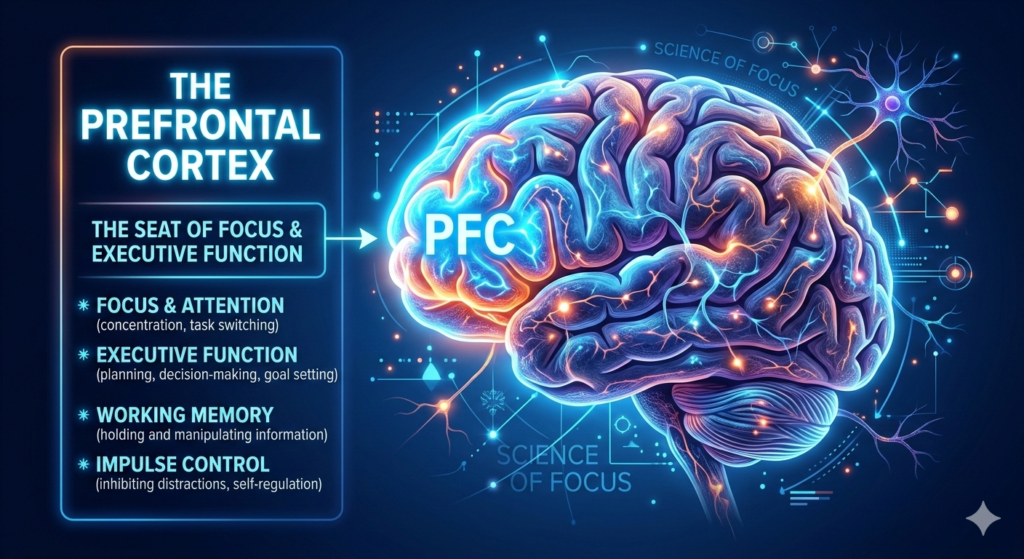
The Neuroscience of Concentration
To improve our ability to concentrate, we must first define what is happening inside the skull when we pay attention.
The science of focus is primarily governed by the prefrontal cortex, the area of the brain responsible for executive functions such as planning, decision-making, and inhibiting distracting impulses.
When you focus on a task, your brain is engaging in a dual process. First, it amplifies the signals relevant to what you are doing. Second, and perhaps more importantly, it actively suppresses the processing of irrelevant sensory information. This “top-down” processing requires significant energy and relies heavily on specific neurotransmitters, particularly dopamine and norepinephrine, to keep the neural pathways firing efficiently.
The Biology of Attention Span
There are generally two systems at play:
- Top-Down Network: This is your voluntary attention. You decide to read this article, so your brain directs resources toward it.
- Bottom-Up Network: This is involuntary attention. If a loud noise occurs or your phone flashes, your brain automatically shifts focus to the new stimulus as a survival mechanism.
Maintaining focus is essentially a tug-of-war between these two systems. Deep concentration requires the Top-Down network to overpower the Bottom-Up network continuously.
Understanding Cognitive Load
A critical concept in the science of focus is cognitive load. Your working memory has a limited capacity. Think of it like a computer’s RAM; if you open too many programs at once, the system slows down or crashes.
When we attempt to multitask, we are not actually doing two things at once. Instead, we are rapidly switching our attention back and forth. This creates a “switching cost,” which drains glucose (brain fuel) and increases fatigue. High cognitive load impairs our ability to filter out distractions, making it harder to return to the original task.
To maximize focus, one must manage cognitive load by reducing external variables and focusing on a single objective at a time.
Achieving Flow State
The pinnacle of human focus is a psychological state known as “Flow.” This concept was popularized by psychologist Mihaly Csikszentmihalyi, who described it as a state where a person becomes fully immersed in an activity. In this state, the ego falls away, and time seems to fly.
Flow is not magic; it is a specific cocktail of neurochemistry. During flow, the brain releases dopamine (for engagement), norepinephrine (for focus), and anandamide.
Flow State Triggers
To enter this state reliably, you need to leverage specific flow state triggers:
- Clear Goals: You must know exactly what you need to do next.
- Immediate Feedback: You need to know if you are doing it right or wrong instantly.
- Challenge/Skill Ratio: The task must be hard enough to be challenging, but not so hard that it causes anxiety.
Why We Struggle to Focus
Despite understanding the mechanics, implementation remains difficult. Modern environments are designed to disrupt the neuroscience of concentration.
“Attention residue” is a phenomenon where a part of your brain remains stuck on the previous task after you have switched to a new one. If you check an email halfway through writing a report, your brain is still processing that email even after you return to the report. This residue accumulates throughout the day, effectively lowering your IQ and ability to perform deep work as the hours pass.
Protecting your attention is not just about productivity; it is about cognitive health.

Conclusion
The science of focus reveals that concentration is a finite physiological resource, not an infinite well of willpower. By understanding the interplay between the prefrontal cortex, neurotransmitters, and cognitive load, we can structure our days to maximize our brain’s potential. Whether you are trying to utilize flow state triggers or simply reduce the mental drain of multitasking, the key lies in respecting the biological limits—and strengths—of the human mind.
Frequently Asked Questions (FAQ)
What part of the brain controls focus?
The prefrontal cortex is the primary area of the brain responsible for focus. It handles executive functions, including impulse control, planning, and the ability to direct attention toward specific goals while ignoring distractions.
What is the “Flow State”?
Flow state is a mental state of operation in which a person performing an activity is fully immersed in a feeling of energized focus, full involvement, and enjoyment. It acts as the optimal experience of human performance.
How long can the average human focus?
While estimates vary, studies suggest that the average adult can maintain sustained attention on a demanding task for about 20 minutes before the mind begins to wander, though deep work sessions can be trained to last 90 minutes with breaks.
Does multitasking ruin focus?
Yes. The brain cannot multitask complex activities. It engages in “task switching,” which creates cognitive costs, reduces efficiency, and increases error rates.