Walk into any modern office, and you will immediately notice a stark divide in how people choose to work. Half of the room will be wearing heavy headphones, piping in music or ambient noise to drown out their surroundings. The other half will be sitting quietly, perhaps wearing earplugs, seeking absolute quiet to complete their tasks. This begs a fundamental question: when it comes to deep concentration, which approach is scientifically superior?
The debate over the optimal acoustic environment is highly nuanced. It turns out that the “perfect” background noise does not exist universally; it depends heavily on the specific task you are performing and your unique neurology. This guide delves into the psychology of working in silence versus utilizing background sound, helping you understand how your personality and your environment intersect to dictate your ultimate cognitive output.
The Science of Absolute Quiet
To evaluate the debate, we must first define the baseline state of an unbothered acoustic environment.
Working in silence is the practice of eliminating external auditory stimuli to reduce cognitive load and enhance concentration. By removing background noise and verbal interruptions, the brain can allocate its maximum processing power to complex problem-solving, memory retention, and demanding analytical tasks without distraction.
Human attention is a finite resource. Every time your ear registers a sound, a small portion of your brain is diverted to analyze whether that sound represents a threat, an instruction, or irrelevant noise. In a completely silent environment, this subconscious scanning is deactivated.
For tasks that require heavy short-term memory usage—such as learning a new language, solving complex mathematical equations, or reading dense technical manuals—silence is universally considered the optimal state. It removes the friction between your brain and the information on the page.
How Noise Impacts Cognitive Performance
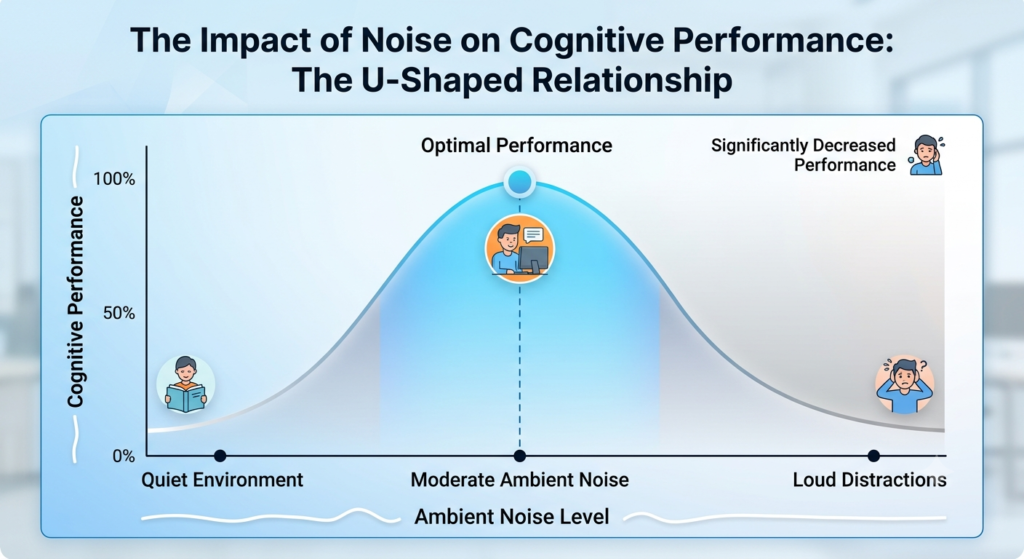
While silence aids analytical work, complete quiet is not always beneficial for every type of task. The impact of sound on cognitive performance operates on a curve.
Auditory distractions, particularly intelligible human speech, are highly detrimental to focus. If you can clearly hear and understand a conversation happening ten feet away, your brain’s language centers are forcibly engaged, pulling your attention away from your work. This is why open-plan offices without acoustic treatments are notoriously terrible for deep focus.
However, a moderate level of meaningless, continuous background noise can actually prevent mental stagnation during repetitive or highly creative tasks. A completely dead, silent room can sometimes induce under-stimulation, causing the mind to wander in search of entertainment.
Introvert vs Extrovert: The Personality Factor
The preference for sound is deeply rooted in human personality. Psychological research reveals that the introvert vs extrovert divide plays a massive role in how we process background noise.
According to foundational psychological theories regarding cortical arousal, introverts naturally have a higher baseline level of brain arousal. Because they are already internally stimulated, adding external noise quickly pushes them into a state of overstimulation and overwhelm. Therefore, introverts generally perform significantly better in quiet environments.
Extroverts, conversely, have a lower baseline level of internal arousal. They often require external stimuli—like music, chatter, or a bustling environment—to bring their brains up to the optimal level of alertness required to focus. For an extrovert, a completely silent room can feel painfully dull, making it difficult to maintain motivation.
Understanding the Library Effect
There is a specific type of acoustic environment that bridges the gap between these two extremes, providing a highly effective middle ground for creative work.
This is commonly known as the library effect. It refers to an environment characterized by a low, consistent hum of focused activity. The sounds of pages turning, keyboards quietly clicking, and muffled, unintelligible whispers create an ambient noise level of roughly 50 to 70 decibels.
Research suggests that this specific level of ambient noise is highly conducive to creative thinking. The slight background hum provides just enough stimulation to disrupt rigid, linear thought patterns, allowing the brain to make novel connections. It proves that you do not necessarily need total isolation to be productive; you simply need the right kind of noise.
Controlling Your Personal Soundscape
Ultimately, the debate is not about choosing one acoustic extreme forever; it is about adapting your environment to fit your current task.
If you are struggling with a highly analytical problem, seek out silence. If you are brainstorming creative ideas, relocate to a space with a gentle, ambient hum. The key is intentional control. Learning how to Use Noise Cancelling technology gives you the power to instantly transition from a chaotic office into a private, focused realm.
When you cannot leave a mildly distracting environment but still need to hear your surroundings (like a parent working from home), utilizing a pair of high-fidelity earplugs is an excellent compromise. These tools evenly lower the decibel level of the entire room without muffling the sound completely, providing a calmer, controlled auditory experience tailored to your immediate needs.
Conclusion
The debate over working in silence versus listening to background noise is not a matter of right or wrong; it is a matter of biological alignment. By evaluating your cognitive performance needs, understanding where you fall on the introvert vs extrovert spectrum, and recognizing the creative benefits of the library effect, you can optimize your auditory environment. Total silence is the undisputed champion for deep, analytical learning, while a moderate, continuous hum can spark creativity and sustain energy. True productivity is found in the ability to intentionally manipulate your soundscape to perfectly match the work in front of you.
Frequently Asked Questions (FAQ)
Is absolute silence better for studying?
Yes, generally speaking. For tasks that require heavy short-term memory retention, reading comprehension, and complex problem-solving, absolute silence reduces cognitive load and allows the brain to process difficult information with fewer errors.
Why do some people need background noise to focus?
This is largely tied to personality and baseline brain arousal. Extroverts, or individuals who are naturally under-stimulated, often require external sensory input (like a bustling coffee shop or background music) to reach the optimal level of mental alertness required to focus on a task.
What is the library effect?
The library effect refers to the productivity boost gained from working in an environment with a low, consistent ambient noise level (around 50-70 decibels) created by other people engaging in quiet, focused tasks. This mild stimulation is particularly beneficial for creative brainstorming.
Are human voices the worst auditory distraction?
Yes. Intelligible human speech is widely considered the most disruptive background noise. Because our brains are biologically hardwired to process language and monitor social cues, overhearing a clear conversation forces the brain’s language centers to multitask, instantly breaking deep focus.