When setting up a home office, most professionals prioritize a comfortable chair, a sturdy desk, and a high-resolution monitor. However, they often completely overlook the invisible element that dictates their ability to concentrate: the acoustics of the room. Hardwood floors, bare drywall, and hollow doors turn standard bedrooms into echo chambers, amplifying every passing car, barking dog, or household conversation.
Trying to perform complex cognitive tasks in a chaotic acoustic space is a losing battle. To truly support deep work, you must actively engineer a controlled auditory environment. This DIY guide provides the foundational steps to tame your room’s acoustics. By understanding the difference between blocking noise and reducing internal echo, you can successfully transform any standard office into a dedicated, quiet sanctuary.

Understanding Your Auditory Environment
Before purchasing materials, it is critical to define exactly what we are trying to control.
An auditory environment refers to the complete acoustic profile of a physical space, encompassing both external noise intrusion and internal sound reflection. Optimizing this environment requires a dual approach: blocking outside sounds from entering the room, and dampening hard surfaces to eliminate internal echoes and reverberations.
When your acoustic space is uncontrolled, your brain is forced into a state of hyper-vigilance. It continuously processes every muffled footstep and rebounding sound wave, scanning for threats or relevant information. This subconscious processing drains massive amounts of cognitive energy. By deliberately designing quiet spaces, you remove this invisible burden, allowing your prefrontal cortex to direct 100% of its resources toward your actual work.
Soundproofing vs. Acoustic Treatment
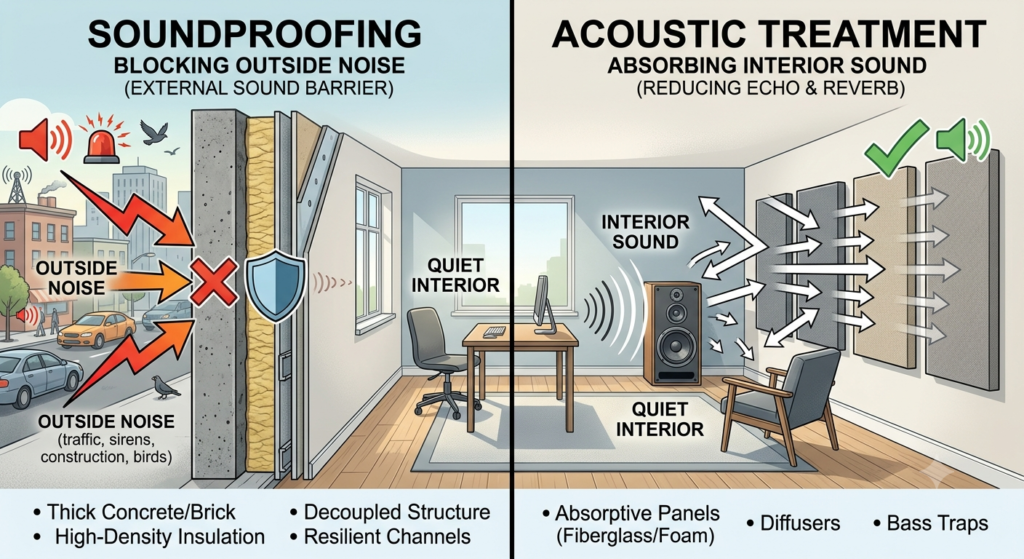
A common mistake in DIY office design is confusing soundproofing with acoustic treatment. They are two entirely different physical processes that solve different acoustic problems.
Soundproofing a room is the act of stopping sound from entering or leaving the physical space. This requires adding heavy mass to walls and sealing air gaps where sound waves travel. If you want to stop hearing your roommates talking in the hallway, you need soundproofing strategies.
Acoustic treatment, on the other hand, deals entirely with the sound already inside the room. Hard, flat surfaces cause sound to bounce back and forth, creating a chaotic reverb. Treating the room involves adding soft, porous materials to absorb these bouncing waves. If your room sounds hollow like a bathroom, you need acoustic treatment.
Strategies for Echo Reduction
The most immediate improvement you can make to your home office is managing the internal reverb. Echo reduction creates a “deadened” room, which feels incredibly peaceful and professional, especially during video calls.
Start by addressing the largest hard surfaces. If you have hard floors, placing a thick, plush area rug directly beneath your desk will instantly absorb a massive amount of downward sound. For bare walls, placing soft furniture, such as a fabric sofa or a bookshelf filled with uniquely sized books, scatters and traps acoustic reflections.
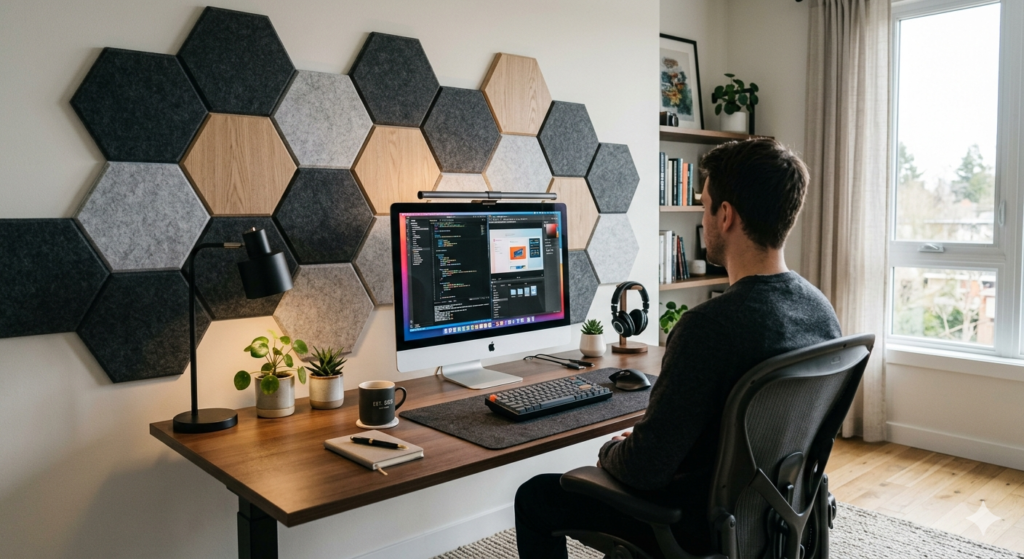
For dedicated, professional-level dampening, you must target the primary reflection points on your walls. Installing a few high-quality acoustic foam panels directly at ear-level on the walls beside and behind your monitors will catch the immediate sound waves. This prevents the sound from bouncing back to your ears, drastically lowering the overall volume and harshness of the room.
DIY Hacks for Soundproofing a Room
True soundproofing requires construction—like tearing down drywall to add dense insulation. However, renters and budget-conscious professionals can implement highly effective DIY hacks to mitigate external noise.
Sound travels through air like water; if there is a gap, noise will leak through. The biggest culprit in most homes is the hollow interior door. Installing a heavy-duty draft stopper at the bottom of your office door and running weatherstripping tape along the doorframe will instantly cut down on hallway chatter.
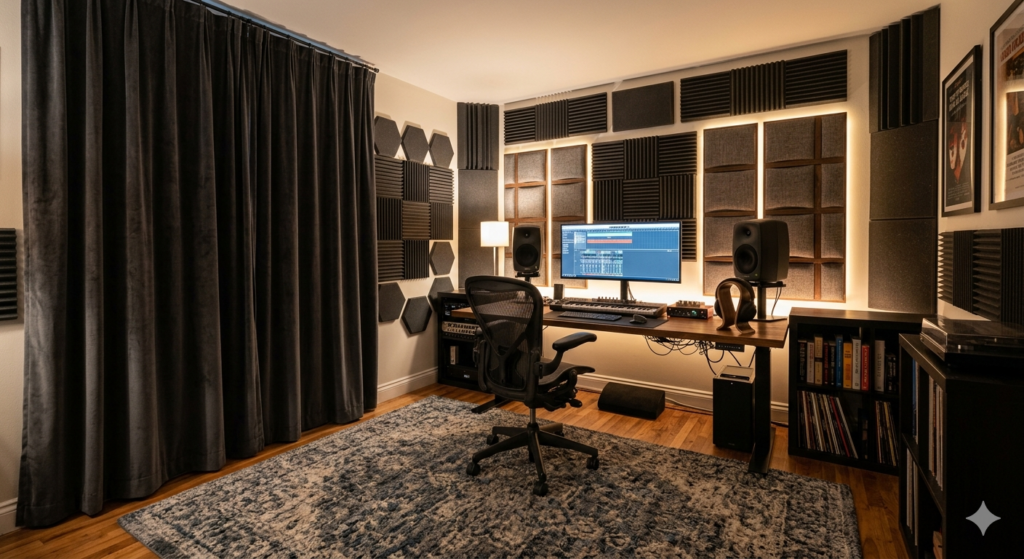
Windows are the second weakest link. To block out traffic or neighborhood noise, hang dense, heavy-duty blackout curtains over the window frames. The heavy mass of the fabric acts as a physical barrier, muffling the high-frequency sounds of the street before they can fully penetrate your quiet space.
Synergizing Your Quiet Spaces
Creating a pristine auditory sanctuary is about layering your defenses. Physical room treatments are the foundation, but they work best when synergized with personal acoustic gear.
Even a perfectly treated room might occasionally suffer from a loud siren or construction noise next door. To build an impenetrable bubble of focus, combine your room’s physical soundproofing with advanced hardware. Learning exactly how to Use Noise Cancelling headphones in conjunction with a dampened room guarantees that external chaos never breaks your concentration.
By systematically addressing the air gaps, absorbing the internal echoes, and layering active sound technologies, you take total control over your sensory input. This environment becomes a powerful psychological trigger; stepping into this quiet room signals to your brain that it is time for serious, uninterrupted work.
Conclusion
Taking control of your auditory environment is a critical, yet often neglected, step in designing a productive workspace. By understanding the functional differences between soundproofing a room and applying acoustic treatment, you can systematically address the specific audio issues plaguing your office. Simple DIY interventions like sealing door gaps, laying down thick rugs, and installing acoustic panels for echo reduction can drastically alter the feel of your space. Transforming a chaotic, hollow room into a dedicated quiet space removes a massive cognitive burden, allowing you to focus deeply and peacefully.
Frequently Asked Questions (FAQ)
What is the difference between soundproofing and acoustic treatment?
Soundproofing involves using dense mass and airtight seals to block noise from entering or leaving a room. Acoustic treatment uses soft, porous materials (like foam panels or thick rugs) to absorb sound waves already inside the room, preventing them from bouncing around and creating echoes.
Do acoustic foam panels block noise from the outside?
No, this is a common misconception. Acoustic panels are too light and porous to stop heavy sound waves from passing through a wall. Their sole purpose is echo reduction—making the room sound less hollow and reverberant on the inside.
How can I soundproof my home office door cheaply?
The most effective cheap DIY method is to seal the air gaps. Install a thick draft stopper along the bottom gap of the door, and use adhesive weatherstripping foam tape along the door jamb so the door seals tightly when closed.
Why does an echoey room make it hard to concentrate?
An echoey room causes your brain to continuously process the same sound waves multiple times as they bounce off hard surfaces. This constant auditory clutter increases your cognitive load, causing mental fatigue and raising baseline stress levels.